Showing posts with label pottery. Show all posts

Saturday, January 1, 2022

New


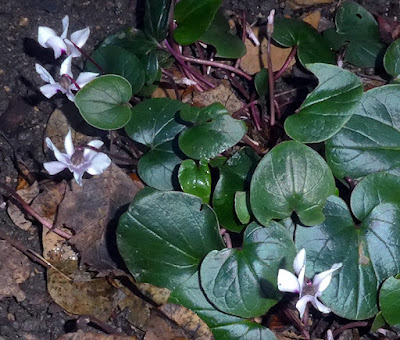
My concept of a new year is not "out with the old, in with the new", it's more "build on the valuable old to create anew".  Nothing is wasted, one hopes.  This photograph of new blooms on my white cyclamen is a case in point.  Year after year I've failed to take photos of white flowers which look anything like what one sees.  I have much experience of what doesn't work!  What I had never tried before was allowing the flash to operate if it liked and he presto! that was the answer.

Our bad experiences happened and I don't believe in denying them.  That way they retain their proper place - bad experiences we have to learn to live with.  Burying things really doesn't help us learn anything.  Some experiences take a lot longer than others to learn to live with.

There is much for me to look forward to in 2022 and a great deal of it involves the new.  I have a sense of not just moving forward, but running forward (if only I were capable of running 😉). I hope to move house and as the autumn went on it dawned on me that I am really downsizing quite a bit.  Initially this was rather daunting but having decided to make a start by aiming to fill my grey bin completely every fortnight it has turned into something of a relief and even a pleasure.  By getting rid of stuff I somehow condense what is left so that it generates so many new ideas.

I am no longer a potter.  I don't think I anticipated this, but for the past two years it's been obvious that this is what I want.  I have fired everything, kept most of the last two firings of pots for myself and am selling everything else as usual.  The kit will also be sold, although I will be keeping tools and lustres and a few decorating colours so I can do some handbuilding work if I want.  I look back on my decades of being a potter with great pleasure, it's just that suddenly it was no longer what I wanted to do.  As an artist, I find myself moving into other things - silver jewellery, photography, mixed media work and of course still textiles.  It's a huge step but somehow so very positive.

The last year there have been many changes in my life because of losing both my parents, my entire family unit, within six weeks at the end of 2020.  What I'm experiencing, as well as the loss and change from what was, is those sudden shards of light which are sparks of ideas of new things on the horizon.  They are exciting.  Some of them have become clearer and are now actual plans, others are still waiting to be unpacked.

The new house (still in Stroud, of course) is a plan: we have exchanged contracts and completion is due mid-March.  Then there will be months of development, planning permission, and finally building and rebuilding and alterations.  As time goes on, the plan takes a clearer shape.

Life is good.  There are bad things in it for sure - somewhat ropey health, illness and problems for some of those close to me, the general situation with the pandemic, to mention a few.  But life is good.

Only one question remains - my alter ego has been known as the Purple Potter for decades.  Should I change it for something else?


Saturday, September 5, 2015

Saying yes

One of the by-products of working as a full-time artist and being single-minded about it is that I have spent a lot of time saying no.  In order to try to maintain the stock levels I would like, I put my work first much of the time so if something was suggested that would interrupt my normal working routine I thought carefully about it but would often say no.  Some people apparently find the discipline of working for yourself from home difficult.  I seem to have found that part easy.  If you work in an office five days a week nobody expects you to be free in the day on weekdays and I have always treated my working week (albeit often longer than five days per week) much the same.

Now I am working part time, one of the main benefits is that I'm able to say yes much more often.  Happily, opportunities have also come along to give me the chance to exercise this freedom.

Last week I spent a couple of days teaching a friend to throw a pot.  I say a couple of days.  We actually had a session on the first afternoon, a short session on the second morning and a third that afternoon.  Vivien has set herself a challenge to complete 60 tasks during the year she is 60, to raise money for her two favourite charities.  Some of these tasks are relatively short, like spending two days learning enough to throw a pot, but some are longer, like learning to play the saxophone well enough to play a particular riff from a favourite song.  Some of the tasks are definitely challenges in themselves; throwing a pot in a short time when you have no previous experience of clay work is one such.

Vivien and I met more than 40 years ago at Eastbourne School of Domestic Economy, where we studied Needlework, Dressmaking, Cookery, Laundry and Housework, (with a side order of Household Accounts plus Typing if you thought you still weren't doing enough).  I know her to be someone well able (if a little out of practice) to use her hands to make things so I was happy to offer making a pot as one of her tasks.

I began to worry when Vivien told me she herself was a tad apprehensive.  But hey, it was unknown territory, who wouldn't be?  I brushed aside my own worried thoughts about whether teaching someone I knew so well over so many years might be as difficult as teaching your partner to drive.  We enjoyed a leisurely lunch together and then went out into the pottery.  It was then she reminded me she's a bit of a perfectionist, confessed she is not as co-ordinated as I thought and dropped the bombshell that she can't copy other people's actions.  Seriously?  How do you teach something practical to someone who can't copy your actions?

"Don't worry," I said, "Over many years of seeing other beginners on courses I attended, I have never seen any beginner as bad as I was." 

The first piece of clay produced a pot, though I had interevened on two or three occasions to 'rescue' it so it was not quite all her own work:


The next few, when Vivien was completely on her own, not so good.  But soon it was time for supper and a long, long time talking together, such that we haven't had the luxury of for many years. 

The following morning I started by making a pot myself while Vivien had hands on from time to time to find out what it should really feel like.  Some more time on her own ...  well, read her blog to find out how that went.  Suffice to say that by lunchtime I began to think that here was the beginner who would make a worse go of things than I had.

We still had the first pot on the board together with a couple of other vaguely pot-shaped items.  So a pot had been thrown.  The task had been done.  Although ....  So finally to the afternoon session of day 2, and this time I didn't touch a piece of clay at all.  Instead, I watched and commented (and took photos) as Vivien worked.  And then ... drumroll please ... all of a sudden there was a pot.

After which, three more pots of a similar size appeared on the board.  So, I still hold the record for the worst ever beginner at throwing.  Not only that, Vivien has completed her task, our friendship is entirely undamaged and I had the best time.  I'm so glad I said yes.


If you would like to donate to a good cause, please do make a contribution to Alzheimer's Research by visiting Vivien's JustGiving page.  It doesn't have to be a large donation but would be really appreciated.  Just say 'yes'.  


Saturday, August 22, 2015

Making hay

Making hay while the sun shines is of course about taking opportunities when they're offered.  I've been doing quite a bit of that recently as I find out what this phase of my life is shaping up as.  I'll write more about the wider opportunities some other time but today I am taking the phrase literally.

When I got up it seemed a pleasant day but when I looked at my favourite (because most accurate) weather forecast site it looked as if the sunshine in the first part of the day was likely to be the last for about six days and furthermore most days we will be getting rain at least part of the day.  It was a case of deciding on priorities for the short burst of fine weather.

I am currently in that part of my working cycle in the pottery where I am finishing off making pots in one clay before cleaning up the pottery and starting the other.  This means I have boards pleasingly full of dry pots waiting to be fired once I have a good mixture of shapes ready in both clays.   I am finishing off with cereal bowls and plates, which take up masses of space on their boards until they are dry, when they can be stacked, so I'm in danger of not being able to make anything else until I can get some things dry.  That was therefore the first priority of the day and here we see lots of things on the ware trolley already half dry.  As the sun is still shining, I am hopeful that by the time the rain arrives, the bowls will be stackable.


The other thing that has been on my mind is logs.  M always collected wood wherever he saw it and I think I have posted photos of various stacks of wood here previously.  In the last couple of years he said it didn't matter if there was too much because that would mean there was still firewood if he was no longer able to collect and cut it up or if he died I would still have a couple of winters worth of wood and of course now is that time and I do have plenty of wood to be converted to logs for the winter.

Last autum I was much fetched with a chainsaw bench I saw in a local shop which holds the chainsaw in a clamp and saves you having to hold it.  The chainsaw is not very heavy and I am able to use it but there are certainly times when my back would rather not be bending at a low angle while holding a moderately heavy electric implement, so I bought the bench.

Since then there have been other priorities outside.  I've got further with the garden, done massive amounts of clearing in sheds and covered ways and generally managed to while away the fine weather we've had.  But autumn is definitely approaching. so a couple of weeks ago I got out the bench and tried to set it up.  Eventually having summoned the help of an experienced friend we established that it would not work!  The handle of the clamp to hold the saw ended up on the wood before the saw did.  A couple of phone calls to the company who make the benches established that this can be a problem and there is an alternative handle, which eventually arrived midweek this week.  So the other obvious job to start while the sun shone was cutting logs.


Less than half an hour's work.  Most enjoyable and satisfying, though disappointing to find how little wood was in the drying area once I got going.  M was a master of the diagonal.  He loved to chuck things in and didn't care much that if they were diagonal they took up to four times the space they really needed.  I'm not sure I'll actually have enough completely dry wood for the winter.  For this reason I've stopped the sawing and now I've finished lunch, will give the rest of the dry part of the day over to organising the woodshed so all the dry wood is one side, leaving room for whatever else I saw up later to dry for the next few months.  And cross my fingers for a mild winter.


Monday, August 3, 2015

The long view

We're often encouraged to 'seize the day' and 'live in the present' and I'm in favour of both.  Thinking of the phrase reminds me that many years ago I had a commission from a C of E vicar, (not sure why it feels relevant, but somehow the choice seemed surprising at the time) to make a hanging to commemmorate the birth of his granddaughter.  Many of my pieces being fishy in those days he wanted "Carpe Diem" with a carp-like fish (and name and birth dates).  He was clearly proud of the pun and actually I liked it too.  I've probably taken more notice of the sentiment since then.

I think it often doesn't look like this to other people, though, because of my tendency to plan.  I love to plan.  I like having things I know about in advance to savour before they happen and I think I enjoy them all the more.  There is a risk of disappointment, of course, if things don't go to plan, but I am usually either modest in my expectations or perhaps just lucky that plans often do work out for me.

Work plans and goals in particular nearly always do work out.  I think this is because I only set achievable goals, though I admit that sometimes they are only barely achieveable and then take a lot of commitment to achieve.  A friend once described me as "single minded" about my work.  It turns out that working part time doesn't make any difference in this regard: I still feel pretty single minded about what I want to achieve and, if necessary, I still put work first.

My work goals are nearly all taking the long view.  There are reasons for this.  Exhibitions and other events need to be booked well in advance.  I suppose you could ignore this and still make work for them at the last minute, but I don't.  I like to have some idea of the mix of work I want available when the time comes.  The other, main, reason for taking the long view is my pottery work schedule, which I've written about before.  What this means is that since I returned to work in the pottery I have in mind new work for the November exhibition and for Christmas sales, and those are what I am working on now.  Things I made a couple of weeks ago won't be finished until possibly October if they are going to be decorated with lustre.   I am continuing with most of my usual ranges but also branching out and making just a few here and there of new shapes.  You'll have seen the new cake plates and they're on sale now.  The others, though, are under wraps until later in the year.

And in a funny sort of way all this still is seizing the day.  I ask myself what I would most like to be doing today and try to do it.  Most days what I want to do is to work towards a plan or two and that's what makes me happy.


Saturday, June 27, 2015

Letting go

If you're a regular reader or know me in real life, you'll know that my working life has been disrupted over the past couple of years by one thing after another and particularly in the last 9 months.  I seem (fingers crossed) to be ok now and able to work in the pottery once more.  It's just as well; stock is very low in both shops where I sell and my showroom here at home is getting emptier too.   But here's the thing: I'm letting go of the idea that low stock means more work to catch up.  It's scary.  But it's also right.

Since last April, when I turned sixty and started receiving my small teaching pension, the idea has been that I can now afford to work part time, which should mean the work/life balance improving a bit in favour of life (in the garden, in the kitchen, with friends, etc).  In practice there was catching up to do at first, and then life went pear-shaped, but when I was able to work I was still doing so more or less full time.  Now, though, the complications seem to be over.  I'm back from my travels and have no plans for any long trips in the forseeable.  There are some nice events coming up but nothing that takes over.  I was looking at throwing myself into the pottery all day and every day in order to try to catch up with stock and orders.  But that way, when would I know it was ok to actually work part-time?  In reality, one never seems to have done enough, so it was unlikely to happen.

So this week I have drawn a line.  I now work part time.  I am still alarmingly low on stock and working part time means it will be even longer before I progress through my usual cycle of throwing and drying and then having a batch of firings, but I am letting go of all those thoughts.  Letting go of the worry that I won't have enough work to sell.  Letting go of the lists of pots I should have made.  It's done.  Life happened.  I wasn't able to work.  But now I am.  Part time.

It's a bit scary.  But I've been self-employed (part time and then full time) for 31 years and I've done ok so far.  I'm letting go of previous pressures and putting my faith in my work, whatever direction that takes me next.


Friday, March 20, 2015

Working again

I'm working again. I'm 'at work', mostly in the pottery,  and therefore busy during working hours (about 8 -6 these days).  There have been several contributing factors to produce this change.

I bumped into a customer on my way to Waitrose, who told me she'd been meaning to phone because she wanted to order a set of breakfast pottery.  Mugs, cereal bowls and small plates.  She's a nice woman, so I explained my dilemma about bereavement and work and said I'd let her know if I thought I could do it by the beginning of May.  (She is expecting visitors from the US and would like to have the pots then if possible.)  I really want to do this order, it's such a nice order to have and I rarely get asked for sets of things.  The customer is very understanding and will wait if necessary.

At that point I was in the middle of a very busy 10 days but had managed to finish lots of things I'd been in the middle of and could see ahead to a couple of weeks with not so many commitments.  This is what's needed to work in the pottery.  As I've mentioned before, you need to be there every day for a while in order to work on things at their different stages as they gradually dry.  I could see that having the order to work towards could be the most helpful thing to get me over the problems I've been having.  To have enough work to do a couple of firings I will need not only to make the pots requested, but a whole lot of other stuff besides.

Then, we had some nice weather.  Followed by very cold again, but the nice weather was enough to show that the winter will end one day and even the unheated end of the pottery will become habitable.

Finally, I was away for a few days.  Nothing like being away for making you really want to be at home!

After a final flourish of days with commitments, I was finally able to get in the pottery on Tuesday this week and with one or two smaller interruptions, have been able to be a potter all week.  And it's working again.

I don't know if this state of things is permanent.  I can't say I'll feel the same next week.  I can't say what other problems may pop up to get in the way.  You'll forgive me if I don't say more just now.

A bit of discipline

When you're learning to throw you want to keep every pot that makes it off the wheel because you are so pleased that it has.

The trouble is that a potter, like any artist, is always learning.  You have never finished learning or you would probably stop.  You may be able to guarantee getting a pot off the wheel, but now you are learning to make a different shape, or now you are aiming at 12 near-identical mugs, or now you are trying to free up your style of ...

So you continue wanting to keep everything.  What is needed is a bit of discipline.

I'm quite good at self-discipline generally.  I know people who are astonished that I can keep chocolate or biscuits or liqueurs or other tasty things in the house for months or even years without eating them all up.  On the other hand, I am, as you know, overweight, partly because of my metabolism no doubt but combined with the fact that I do like to eat more than I need, so 'quite good' at self-discipline is probably about as good as I'll get.

In the pottery I am also 'quite good'.  I am moderately strict about what is let through, but not rigorous.  One thing I have always done is to follow the advice of the person who taught me most of what I know about being a good potter*, Douglas Phillips of Ridge Pottery in Somerset, and occasionally cut a pot in half to look at the thickness of the walls and base.  Are they even?  Are they the thickness you thought they were and is it a good thickness?


Here's one I cut up yesterday.  It's a one-person teapot, one of four I made the day before.  As I was rolling the base to tidy it, the centre of the base curved in.  This is usually because the pot is not really firm enough for rolling the base yet and doesn't really matter in a finished pot apart from aesthetically.  It can sometimes be, though, because the base is too thin.  I was feeling a bit more rigorous, so I decided to cut it in half.  Base not too thin, though slightly thinnner than the rest of the teapot.  The walls of the rest pretty even too, and it was a nice shape, so I was pleased with what I saw.  To be really self-disciplined, I think you have to not mind finding you have a cut a good pot in half.  I didn't.  So that was good.


* On the matter of how not to be a good potter, I am entirely self-taught.


Sunday, November 23, 2014

All that glisters is not gold

 ... though some of it is.  The rest may be platinum, copper, bronze or coloured lustres.


For the second year, I've produced a limited edition range of lustred mugs.  Last year's mugs had multicoloured spots and this year I've divided the lustres up so there are two colourways - blues, greys and silver (platinum) and reds, oranges and gold.  There are two sizes of mug, extra large and small.  The mugs are available directly from me at my studio or on my stall at Stroud Farmers' Market and will be available in Arcade Artisans at the beginning of December.  I hope you like them.

I've also made more small lustred mugs in the leaf design.  Each mug is unique but you can see a common design.  Here is a small selection of them.


As a postscript, I'd like to draw your attention to the title of this post.  We don't use the word 'glisters' any more as a rule, but I still love what many see as archaic language.  It often has a beauty to it and for my money subtle but important differences in meaning which are often hard to explain.  There is a difference between 'glisters' and 'glistens', the word now usually substituted in the well-known saying.  I prefer the original.

Shakespeare, natch.


Wednesday, October 29, 2014

Exhibition news


Once again I'm exhibiting at The Cotswold Craftsmen Gallery, in an exhibition called, imaginatively, "CLOTH and CLAY".  It's a smallish exhibition space - what you see here is most of my exhibition - but it really suits my work.  I can display the complete mixture of what I make in a way which allows all the component elements of my artwork - ceramics, pictures, scarves, accessories and cards - to come together in a single whole.


Life is a bit difficult and stressful at the moment (hence even less blogging than usual, apologies) so I'm particularly pleased to have put together an exhibition I'm proud of.  I know most people reading this blog live too far away to visit, but don't forget you can always contact me if you want to know more about anything you see in these photos.

Saturday, March 29, 2014

Exhibition news


I hope lots of you will be able to visit the exhibition.  I'm really pleased to be exhibiting with these other artists and to be working to a different theme.  As there are six of us, I will be selecting work - old and new- which resonates more particularly with the theme of "Grounded". 

Look out for some different coloured spotty mugs!  There is a collection of green and brown themed spotty mugs which are for the moment "limited edition" in number, though if they prove popular I may make more of them.  And there will be .....  well, you'll have to come to the exhibition to find out what else I'm making .....


On a different subject, as an update, I'm delighted to say that I raised £270 for ShelterBox with my wallhanging raffle.  The hanging was one by a customer who came to my stall at Stroud Farmers Market.  Thank you to all who donated.

Monday, March 11, 2013

What price experience?

On Saturday I put the wrong set of pyrometric cones in the kiln when I packed it.  The ones that went in were for my high-temperature firing.  The kiln was loaded with pots glazed in oatmeal, which is fired to a lower temperature.

I only realised my mistake when I was wondering why the kiln was taking so long to come to temperature and I suddenly remembered what I'd done.  Cones are how I know what heat-work has been done to the pots, so they are of vital importance.  I rely on them.  The pyrometer shows climb and fall and what it shows is roughly related to the temperature inside the chamber but recently the figures had been changing dramatically and after a repair to the pyrometer I didn't know whether it would behave as it had recently or before it started to go wrong.

So I had to make a judgement about when to stop the firing, based entirely on my own experience of the kiln, together with some guesswork about the pyrometer.  Too hot and the colour would be wrong.  Underfired and the pots would be unusable.  One can refire but that has its own risks.  There are a lot of pots in a kilnful.


Front shelves

This is what greeted me when I opened the kiln this morning.  These pots look exactly as they should.  The kiln has been fired to the optimum temperature.  Right on the button!

I am, of course, mightily relieved.  But I'm also really proud of myself.  This is the best result I could have hoped for and it comes as a result of my own judgement.  I have a lot more useful experience as a potter than I sometimes think I do.  What price experience?  Several hundred pounds worth of pots in this case. 

As self-employed, sole trading artists I think we often forget the value of experience.  "I could do that" is often heard from visitors to craft markets and the like when looking at handmade products and then looking at the price.  And it's possibly quite true.  However, my experience means I can more or less reliably produce the items I'm asked for, time after time.  It also means I work much more quickly than someone who is not working full time at it and what price experience in this case means that I'm able to charge a lower rate than otherwise for my products because I'm reasonably fast at making them.  And it means that if things go wrong I stand a good chance of being able to fix them!

I run occasional workshops in silk-painting, free machine embroidery and other textiles skills and recently have been doing some tuition sessions on a one-to-one basis and as it happens, I've been thinking about place of experience in this work too.  The fact that even people who have a flair for the work (which my students do) sometimes need tuition is not because I'm better at it (I'm not sure I am) but because of what I have learned in my many years of experience, both of the materials and skills themselves and about how people learn to use them. Experience is what I am being paid for as a teacher.

What price experience?  Possibly more than I'm asking!


Back shelves


Tuesday, February 26, 2013

J is for Juggler

Look carefully and you'll see a letter J bottom left of the mug, blue on green.  Then even more carefully and you'll see a silhouette of a juggling figure and three juggling clubs.

Well, I did say you had to look carefully.  I made this mug many, many years ago, at a guess probably about thirty years ago.  At the time I was attending pottery summer schools each year at Ridge Pottery.  I spent my weeks there each summer trying out different decorating styles as my skills increased.  This one uses slip.  The juggler and clubs are made by wetting newspaper cutouts of the shapes, attaching them to the pot before dipping in blue slip  The newspaper peels off when the slip dries out.  The letter is painted on through a newspaper stencil.

I might have got into more slip decoration eventually but the particular clay, glazes and firing method I use don't respond well to dipping in slip, so this was one idea which fell by the wayside.  I have a feeling that that particular year I made three or four others of these for friends as presents.  But it's a long, long time ago. 

In the mean time, though, J is for juggler in the sort of working life I've built up.  I like all the different components and mostly do manage the juggling well.  Today, though, is one of those rare days when the clubs all fall to the ground.

What with making the Hen Portraits, putting on Another Beastly Art Exhibition and a week of tidying loose ended jobs along with fitting in a number of teaching sessions, I haven't been in the pottery for several weeks.  The situation is becoming more pressing as pots are needed that will take a few weeks to produce.  So the week ahead was well planned.  Two teaching slots on Monday, Tuesday and Wednesday in the pottery all day, Thursday cooking and arranging the house for a bring and share, Friday teaching first thing and handles on mugs made on Tuesday and on Saturday I'm going to be attending my first ever school reunion.

The clubs all fell to the ground when I found that the clay I thought was kept just right in an old fridge had gone hard.  New clay much too soft and will take a day sat out in a heated pottery. 

Not enough raw materials for a spontaneous glaze mixing sessions.

Sewing machine booked in for servicing today so couldn't finish a couple of projects which would have been usefully tidied out of the way.

So, failed juggling.  I'm finding useful things to do, of course.  Putting together an order of glaze materials, for one!  Another couple of orders for silk-painting supplies.  Packaging up an order to go in the post.  It's not the same, though.  I really, really wanted to be making mugs today.

Thursday, March 22, 2012

A potter's day

For many years a regular feature of Ceramic Review was “A Potter’s Day”. Always on the last page of the magazine, it was a whole page written by a different potter each month and always showed as much about the personality and lifestyle of each potter as it did about their work. Recently this feature seems to have been stopped so I thought it would be interesting to write one of my own.

I usually wake quite early. I’m a lark rather than an owl and rarely need an alarm. I generally aim to get up around 7.00 - 7.30 on a weekday. A lifelong Archers listener, I now have the luxury of “Listen again” via the internet so listen to yesterday evening’s episode while I have breakfast and start on desk work.

Today I need to finish a newsletter for Crafts In Gloucestershire. I love admin tasks and am a bit of an internet addict so this is an ideal vehicle for my technological skills, which are increasing all the time. The newsletter is fun too because it’s a bit of design that doesn’t need me to be good at drawing. As usual, other arts and crafts folks, who mostly don’t like any kind of admin work, are slow in sending me any news so I try to find work I feel is vaguely seasonal from the photos I already have. If I haven’t got too much admin to do, I’ll probably fit in a household chore at this point, like putting in a load of washing.

By nine or nine thirty I’m in the pottery. Time markers feel important to me so if it’s gone 9.05 then I’ve definitely missed the 9.00 start and continue with the desk work or chores till it’s 9.30.

Pottery work has a rhythm and life of its own. You don’t just pick it up for an hour or two and put it down. Most days the first work of the day is already mapped out by what was done yesterday or the day before and the last is in preparation for the next day. Today the first task of the day is to turn some fruit bowls I made two days ago. They’re just right now but by this afternoon would be too dry without a lot of faffing about. I don’t turn many things (fruit bowls, colanders and lids) but it’s a process I enjoy.  

After finishing the fruit bowls I put them on the ware trolley in the unheated part of the pottery where at this time of year they’ll dry out slowly, along with some large colanders with handles and some teapots that were finished earlier in the week. Then, after a coffee break (more newsletter work) I make some cereal bowls. It’s a lovely sunny, spring day and I want to take advantage of that. You can hurry the drying of most pots just after they’ve been thrown and cereal bowls take up so much room in the workshop until they’re bone dry and can be stacked so it’s good to get them outside to start drying, where today there’s a light breeze as well as the sun.


Once the bowls are outside drying, I go in to the house for lunch. Lunch is usually toast - light, quick, and cheap! With a coffee afterwards I often weaken and have a little chocolate. I spend at least an hour, often an hour and a half on my lunch break. I have an occasional back problem and varying activities is essential so this is a good way to break the day up with more desk work. After my fix of catching up with Scrabble games on Facebook (did I mention I am a bit of an internet addict?) and answering an email from a prospective workshop student I make good progress with the newsletter and leave it at a point where I know it can be finished by the end of the day.

Back in the pottery I put on an audio book. I listen to music in the morning - usually Classic FM or my own CDs - but by the afternoon I often want more distraction. The teapots will need lids so that’s this afternoon’s work mapped out.
 I make the lids “off the hump”, which means you centre just the top section of a large “hump” of clay and throw the lid from that. The lid (currently ‘upside-down’) is then cut off the hump with a length of thread which you allow to twist around before you pull it straight out. The lids are left to dry to leather-hard and then tomorrow or the day after the lids go the right way up, the top of the lid is turned to its final shape and a small piece of soft clay attached, which is thrown into the knob.

By the time I’ve finished the teapot lids, the cereal bowls I made this morning are firm enough to be handled and have their bases smoothed and finished and my potter’s stamp pressed into the base. The day is losing its warmth now, so they can stay inside. I get some clay out to firm up overnight so it’s ready to throw with tomorrow.

It’s about five now and I usually stop for a drink of some sort. Often I’ll go out to the pottery again but today I’m finishing earlier. I pick purple sprouting broccoli from the garden - broccoli cheese for supper - before it gets dark and then go in and finish the newsletter before switching off for the day at around seven.

Tuesday, April 19, 2011

A little bit of alchemy - part 2


The science of glazes is, well, very scientific.  Many years ago I attended a course on glazing with Mike Bailey as a guest tutor.  Mike used to be one of the potters at Bath Potters Supplies, where potters from surrounding counties go not only for materials and equipment but for valuable advice.  Mike was always the one to ask about glazes.  As a tutor he was informative, thorough, inspiring and enthusiastic not only about what he was telling us but about what we were asking him.

As I have mentioned before, much of what I know about potting I have learned from Douglas Phillips (on whose glazing course Mike was the visiting tutor) and because he uses the once-fire or raw glaze method, so do I.  This means that instead of firing pots first so that they are 'cooked', (called 'biscuit' firing and the pots are then biscuit ware) before glazing and then re-firing to a higher temperature, I glaze the bone-dry pots and then fire once.  This saves fuel, naturally, and time.  Why would one do any different? Well, there are disadvantages to raw glazing.  The glazes are often very different from other glazes because they need to contain a certain percentage of clay in order for the glaze to 'fit' the pots.  When glazing unfired pots, any unevenness in the pot can create a stress when the water from the glaze is quickly absorbed into the pot.  You can easily imagine that in a thin section the clay becomes saturated (and therefore swells) while in a thicker section it does so much less.  So you can get pots cracking when you glaze them because of this.  Or when you fire them.

Then, there's the glaze recipes themselves.  The best way I can think of to explain this to those who know nothing is to liken a glaze recipe to a cake recipe.

You want to make a cake.  You have in mind a sponge.  You know roughly the proportions of fat, sugar, eggs and flour.  If that were a glaze recipe, though, then this classification by ingredient would be very primitive.  No, what you are required to judge is the correctly proportions (correct, mind you, not rough) of protein, fat, carbohydrate, vitamins, minerals, water and fibre.

So, you find out how much fat there is in an egg.  Add that to the fat in the butter.  7 grams out.  Use a little less butter.  But butter contains a little protein and now you have disrupted the exact amount of protein you need.  Reduce the eggs by one and now you have far too little protein.  Oh well, let's make it into a walnut sponge.  Walnuts have protein in.  Yes, but they also have fat, which you had too much of in the first place.  Somewhere here is a balance of the number of walnuts and eggs and fat and then you can adjust the quantities of sugar and flour so that the proportions are right.  You are probably getting the idea now :)  Anyway, Mike Bailey taught us how to calculate these properties of the glaze using triaxial graphs.  It involved a lot of maths and I found it fascinating and hugely enjoyable.  Now I look at it all and I'm aware of two things - a) I've forgotten a lot of it through disuse because of lack of time, and b) I'm still fascinated with this kind of process.  You'll have gathered from previous posts that lack of time generally wins hereabouts.

Your regular potter, though, doesn't usually bother with all of this.  There are glaze recipe books.  Other people have done the science and then used the glazes and proved their worth, just as in cooking.  If you're no cook, you can buy premixed glaze ingredients where you just add water, just like packs of scone mix or sponge mix.  There's room for all of this in the wonderful world of pottery.

If you're a raw glazer, though, you are a specialist.  There are very few recipe books for raw glazes.  In fact, I don't actually know of any.  You will, though, find glazes in general books which either state that they can be used for raw glazes or look promising because of what you already know you need to include.  You can try these.  Most of them will not work for raw glazing.  Or, you can rely on the generosity of other potters to pass on their recipes.

I use two recipes dictated to us on courses at Ridge Pottery year after year.  The other two glazes I have adapted from one of Douglas' original glazes by playing around with the triaxial graph method, having read around the topic of the sort of colours I was trying to produce.

Only four glazes?  But we've seen many more than four colours on your pots!

Well spotted.  You have indeed.  And that's the alchemy.  Remember all those factors in the firing process.  Well, add that to four glazes combined with two different clays, a couple of coloured slips and some decorating glazes and you get the picture.

I expect you're a bit bored with all this technical stuff now.  Me, I could go on for ages.  Writing about things in this way gets me back in touch with aspects of the work that I sometimes neglect.  I'll spare your feelings, though, and stop here.  You've seen the photo at the top of this post.  You may remember there was a photo of some glazed pots in the previous alchemy post.  Well, they were the same pots.  Just to illustrate that what you see before the pots are fired often bears little resemblance to what they look like afterwards, here are the two pictures together.


Magic, isn't it?

Sunday, April 17, 2011

A little bit of alchemy - part 1

I know it's not alchemy and I know it's not magic.  I realise that to a scientist, it's just that when you mix certain minerals together and subject them to different physical conditions this will result in changes to the nature and appearance of those minerals.  However, I never got to even try the smallest taster of chemistry or physics at school so it's still possible for me to hang on to that little bit of mystery about what happens to clay and glazes when you fire them.

There are clays, glazes and firing methods which appear (to one who doesn't use them, anyway) to be able to produce fairly predictable results.   Mine are not among these.

The firing process is probably the single most unpredictable part of what I do.  I fire using gas, so that there is actual fire, flame, within the kiln chamber.  You get this with wood-firing, of course, which I love but would never have wanted to tackle myself.  I was lucky enough to spend a  week or two over a couple of years helping out at Ridge Pottery when I was still very much a learner myself and had the opportunity to fire a wood-fire kiln on several occasions.  It was daunting at first but by the second occasion I really loved the experience.  Of course I was overseen very carefully, but I still learned a tremendous amount about the process of turning malleable clay into vitrified pots as well as about wood-firing itself.

Wood firing is hard work.  It also requires plenty of storage space to season plenty of wood.  It's not for me.  However, the live flame you get from a gas firing can be the next best thing.


To explain this picture a little:
The lower part shows the kiln, with the light reflected very brightly off the front of the door, which explains the very light area on the left.  To the right of that is a metal shelving unit, dexion type.
Above the kiln at the back is a hood leading to a ventilation pipe.  The bright orange/red area you can see is a reflection on the inside of the hood of the inside of the chimney.  At this stage the colour of the atmosphere in the kiln will be much yellower as it is hotter. 
You can also see a blue area in about the centre of the picture.  This is flame emerging from the chimney of the kiln.  (The chimney in this case is not a tall, high thing but is an area at the back of the kiln which is only the height of the kiln itself.)


Live flames in the kiln chamber also allow you to manipulate the atmosphere in the kiln chamber so you get a process called 'reduction'.  Basically, you push too much flame too fast into the kiln so that it uses up all the available oxygen in the atmosphere and has to take more from the oxygen-bearing molecules in the clay.  At the same time, the flames will be escaping the kiln.  This is what's happening in the photo.

Reduction often results in a speckled appearance but it also often changes the actual base colour of the glaze. 

There are many other factors in the firing which induce variation in the finished results.  These include:
  • the exact position of the kiln shelves, both in relation to the burners and kiln walls and in relation to the pots.
  • the spacing of the pots
  • what types of shapes of pots are next to each other
  • which glazes are next to each other
  • whether your kiln is full of smaller pots or bigger pots
  • whether your shelves contain both smaller and bigger pots
  • the rate of climb of the temperature at every stage of the firing
  • whether the gas bottles need changing at a crucial stage and especially if you don't notice for a while!
 At this point some of you will be wondering why I fire by such a seemingly unpredictable method.  But maybe others will be thinking how exciting it all sounds!  Who wants predictabilty?  Well, of course, I do, to some extent.  Some of the problems I've been having with the work over the last year or so have been in trying to get to grips with how this particular kiln works best and then having got a long way in discovering that, in adapting what I do so that the differences in firing methods (tiny and subtle, but astonishing in their results) still produce results I want.

Goodness.  Sorry.  All very wordy.  But I really couldn't explain much about the firing process without.


Part 2 of "A little bit of alchemy" will be more about glazing.


Tuesday, March 22, 2011

Work cycles


We're all different.  Thank goodness.  The world would be very dull if we weren't.  For every human characteristic there seems to be a continuum and where you are on it can have wide-reaching effects.  Artists and other creative people have a reputation for not being good at admin and it's often said that I am unusual in not only being very good at it but actually enjoying it.  It's true.  I've always enjoyed being organised. 
It's just as well.  Balancing all the different components of my working life needs careful planning and an eye for far-reaching implications when surprises turn up.  Some of that is because I do different things within my working life - pottery, textiles, cards, working within organisations, to name but four.  The rest is to do with the constraints of making pottery generally and, I have to admit, some created by the particular work that I choose to do.

Working in two clays in a smallish workshop with one wheel means that I can't just swap between clays on a daily or even weekly basis.  There's a day's organisation in cleaning all the tools, the work area, etc between using one clay and another and it's not a job I enjoy.

Another factor is what happens in the kiln.  Within the glazes that I use, different glazes require slightly different firing temperatures and since my kiln fires unevenly (as most seem to, to some extent or other) I achieve this with mixed firings.  Also, in the grand scheme of things it's not big - about 10.5 cu ft - but you can get a lot of pots in there and I can't imagine ever needing to fire a whole kiln full of one type of pot.  As an example, if I fired nothing but mugs, I'd probably be looking at more than 90 mugs (although I would have a shelf left over that wouldn't be high enough for any more mugs but would take cereal bowls.)  I never need 90 mugs at once.  I always need 45 mugs, 20 cereal bowls, a dozen dinner plates, a few salt pigs and some fruit bowls.  And in case you're wondering, no, I wouldn't get all of those in one firing either!

So, firings are necessarily very mixed.  I do also fire to two slightly different temperatures, so that's another element of variety added to the mix.  It will now be clear why I need to have lots of all sizes of pots in both clays to start firing.

So, at last, I come to the point of the title, work cycles.  My pottery work cycle is that I spend a couple of months or more at a time making pots in one clay.  During this time I may have enough of the other pots to fire but often not.  Then eventually I have made all the white clay pots I'm going to, as you see in the picture above, and I can start on the other colour of clay.  That's where I am now.  This morning I began throwing pots in the brown clay.  It feels really good to be at that moving forward sort of stage, especially as the weather has been so springlike and there is a general feeling of regeneration.  I've been busy with a few other things for about 10 days so it's also good to get back into the pottery in general.

What next?  Well, next there need to be enough pots in brown clay ready to fire so that I can actually start on some firings.  After that ...  well, that's for another day, I think.


Thursday, March 10, 2011

Work in progress - 2


As promised, a progress report about the lizard vase.  You may be able to see here that it is now a fairly uniform white in colour.  That's the first way to tell that it is dry but you also have to feel the pot.  If it's in a reasonably warm room it should feel the same temperature as the room.  If it's still damp, it will feel slightly cooler.  Finally, if I'm not sure, I press the pot to my cheek as there is a better sensitivity to damp on the skin there.  In this case, though, I know the pot is dry and in any case it's now sitting waiting for the next stage.

So, the lizard has survived the drying out stage.  This is actually the least precarious.  They nearly always do survive drying out.  The next thing will be to decide on the colouring I'm going for.

This is not an easy choice.  I don't have many glazes and on this clay there are really three colour choices - a greyish white, such as you see on chicken pots, a creamy colour which is on the cream lustre pots and the colour I have called "heather" because it reminds me of the heather moors in Yorkshire in all its varieties.  


What makes things more complicated is the choice of oxides, colouring glazes and lustres that will go on the lizard itself.  With experience, one quickly learns some good and bad combinations of these but there is plenty of unpredictability in these things and I have to allow for that in what I plan to do.  I think it depends how I'm feeling generally what level of risk I enjoy.  Sometimes I want to play safe with a combination that almost always works and sometimes I'm in the mood to just go for something a little unexpected.

The jury is still very much out about how to glaze and decorate the lizard vase.  I may be moving towards a decision but I'm certainly not going to announce it here until its done.

I may have mentioned before that for most pots I do only one firing.  This is known as "once-firing" (subtle, eh? ;) ) or "raw glazing" because the pots are raw when glazed.  To extend the cooking metaphor, the majority of UK potters probably don't do raw glazing and therefore their pots are cooked once before glazing.  This is known as "biscuit firing" and the resultant pots as "biscuit ware".  Completely unfired pots are "green ware."

So you take a bone dry pot and ruthlesslessly swill a whole lot of wet glaze around its insides before dunking it into more glaze and then placing it back up the right way on a board.  Glazes are made of powdered minerals suspended in water.  Raw glazes have a high proportion of clay in them to make them "fit" the pot and a consistency between single and double cream is what I go for.  Still plenty of water around, though, which will of course soak immediately into the bone dry clay.  If the thickness of the clay is uneven, the soaking of the liquid won't be even either and, particularly where the clay changes thickness, the pull of soaked clay against unsoaked clay can cause fractures.

Are you ahead of me?  Yes indeed, lizards and their tails do present sudden changes of thickness of clay on a pot.  And that, Best Beloved, is why so many lizard pots end up as casualties, either at the glazing stage or the firing stage, where there is a similar problem with water content and thicknesses.  And why I'm not going to tell you how I decide to glaze and decorate the lizard vase until I know it has at least survived the glazing stage.

Thursday, March 4, 2010

Small but perfectly formed.


Well, not me, obviously! But take a look at Chicken Pots. This new site is just for online sales of, well, chicken pots! The limit of five products on the free webs.com sites makes them just right for focusing on one design of pottery. I must say I'm particularly pleased with how the site has turned out.

I've only really got plenty of stock in this one design, but have ideas for more mini-sites in due course.

Saturday, February 20, 2010

Batts R us


I'm sorry about the title, but I couldn't resist.

As I mentioned recently, I've been making my own batts. You can buy them ready-made, of course, but large ones cost about six pounds each. I made nine large ones, ten small ones and four pot boards from one eight by four sheet of marine ply which cost me less than thirty-five pounds. Do the math, as they say in the US. It's not only the money, though. I really enjoyed working with wood again.

Since M came to live here I've hardly so much as sawn one cut of wood because he has skills in traditional blokish things like building and working with metal and wood so I have mostly handed things over to him that he can do. What he doesn't have, though, is finesse of measurement so when we finally decided that we would have to make a new towel rail, a sensible sized replacement for the broken one being quite impossible to buy, I became a little more involved. First, M suggested I provide him with a template for the rounded ends of the pole supports. I asked if he would like me to cut them with the jigsaw as well and, slightly to my surprise, he agreed. He has a jigsaw, of course, but I've had my own for about twenty years so I fetched it out of the cupboard from exactly where I knew it was kept (disorganised, him? surely not!) and set to. It took a little while to remember the best way to use it, but I really enjoyed working with wood again.

Once upon a time, when I was a full-time teacher, in the days when school holidays were holidays for teachers as well as children, I did all my own DIY. I didn't do any plumbing or electric work but there wasn't much else I didn't have a go at. Not just DIY, either. In my twenties I learned to make a lot of different things from different materials. I must have earned a reputation for it, too, because I remember buying a rather nice little rush-seated footstool and being asked whether I had made it myself. I think people expected that if you could make something, I had. It wasn't far off the mark. Gradually, though, work took a larger part of my time and in recent years I've hardly had time for anything else. So it was a great joy to be making the towel rail components. Having cut all the pieces, I used my electric sander to round the edges further. The project now awaits the next stage.

Having got out the jigsaw, this led naturally to the decision to make my own batts. Throwing batts have to fit tightly onto the wheel and the usual way is to have two metal pins in the wheel and two matching holes through the batts so that they just sit in place. I had never had a wheelhead with the holes in before so my last lot of batts were cobbled together with a home-grown system of four blocks screwed to the back of the batt in such a way that it gripped over the top. It worked fairly well but over the years the batts have warped and slightly shrunk so that the fit is not so tight and some of the batts go up and down as they go round. So - new wheel, new batts.

Cutting the rounds was fairly easy. They're not perfect, of course, but they don't have to be. Drilling the holes was more difficult. There were not many that were exactly right first time and I still don't really know why! It wasn't difficult to enlarge one of the holes in the right direction, though, and all the batts fit just right on the wheel. I shall be using them next week.

Friday, January 29, 2010

The course of true love never did run smooth


I think I will probably end up in love with my Whisper wheel but it has not been an easy start. If I have more than one problem of the same sort my distress tends to escalate exponentially and so it was with the Gremlins. So when my Whisper wheel didn't, I may possibly have overreacted but I may possibly be forgiven for doing so.

The really stressful aspect of the problem was the completely unknowable timescale of getting to speak to someone about the problem. As I mentioned before, the people at the suppliers had been off sick since before Christmas and were still unable to get up and into work. Eventually, though, they were back at work during the course of the week (although still sounding a bit rough, to be honest) and I was able to speak to people who knew things.

I had been adamant that a brand new wheel when taken out of its original packing should have been left in a perfectly working state and therefore I was insisting on a replacement but Mike at Potters Connection reminded me that they had taken the wheelhead off to drill holes for fixing batts and said perhaps they had not tightened it up quite enough, the 'key' for the wheel being still in its packing at the bottom of the box.  He was most apologetic for this and was willing to travel down from Stoke to Stroud to see to it if I had still not been happy.  However, M and I took it all out of the box again and although I didn't really feel there was any tightening to do, after trying, the clonk had gone.  I was really very glad not to have to make the poor man make the journey when he clearly still wasn't feeling his best.

One very happy and entirely unexpected discovery was that at least one of my splash trays from previous Shimpo wheels was compatible.  This is good because I have small strips of stainless steel bolted to the sides for scraping hands and because I like to swap splash trays when changing clays rather than thoroughly cleaning the tray out.  As you can see in the photo, thorough cleaning of splash trays is not my forte.

So - all well and good?  Well, no, not really.  In case your nerves can't stand it, perhaps I should add that it is all well and good now, but it wasn't immediately.  We put everything back where it was wanted, M moved shelf brackets that were now too low for the new wheel to fit under and I started to work.  The previous day I made the first attempt at throwing for a couple of months and although my rib injury was complaining, I had decided that doing stuff might be the way to full recovery now rather than resting it and not doing stuff, so I was keen to follow up by making the lids to go with the casserole dishes of the previous day. 

I could not throw.  I just could not centre the clay.  First, I thought it must be because the wheel is slightly higher and I was working at a different height, but we tried raising the chair on some blocks and it made no difference.  Then I thought perhaps the clay had somehow (though I couldn't think how) become uneven and that was causing the problem.  So I took myself and the clay through to the cold end of the pottery and tried a piece on the old wheel.  Perfectly alright. I was convinced (as was M) there must still be some problem with the wheel.  I phoned a potter friend, who said he thought perhaps it was just that the wheel and I needed to get acquainted and then I phoned Potters Connection who said more or less the same thing.  Give it a few days, they said.  This was not encouraging to someone who could really only do an hour or so a day. 

Eventually I saw that I had no option, so I went back in to try again.  And this is where some kind of explanation formed itself.  I studied what was happening and realised that the new wheel is much faster than the old one.  I had been trying to throw as if the wheel was identical.  Additionally, I decided that the foot pedal, although not appearing particularly light of touch, was in fact sensitive in at least a different way, so it was possible that a very slight increase in pressure as I leant forward was changing the speed.  I made the appropriate adjustments and hey presto! of course I can now throw again.

All of this would make me feel rather stupid, you can imagine, were it not for what I think is the explanation.  I've been aware for a long time that I have a very particular connection between mind and body.  In some ways the connection is stronger and clearer than for some people but in others there's just something missing.  For some reason, noticing an 'obvious' increase in speed had not been straightforward for me. I find it difficult, at this point at least, to explain what I mean by this but I am fairly sure that it's not unrelated to other mind/body difficulties.  How many other people do you know, for instance, who feel motion sickness for the first two or three weeks of driving a new car?  It's always happened to me.  I have other peculiar difficulties here and there which add up to some kind of problem between mind and body.  None of them are too severe, but they can, as in this case, require concentration to overcome.

So here we are, my Whisper and I, after almost two years of my wanting to own one and after so many initial difficulties.  I've always thought Shakespeare meant that if there aren't a few problems, it's not true love so I'm beginning to feel very encouraged by overcoming what seemed like rather serious problems.  The Whisper really does whisper.  Gone are the days of having to play CDs at full volume and needing to select music that does not vary in volume.  I can now once again play symphonies and concertos without losing everything except the ff bits under the twangy buzz of the wheel.  I can choose the music, or silence, that most suits my mood.

It already feels different.  Making pots is not just a mechanical thing - one's inner processes always affect the quality of the work.  Over the last two years my predominant inner process while throwing pots has been a rather tense struggle to ignore the horrible buzzy groaning that filled the pottery.  I had thought that a lot of the tension came from the pressure I was putting on myself to make sufficient work but now I remember why I love making this work and I think I had underestimated the effects of the noise.  There is a particular mixture of physical skill, intention of design and spiritual contemplation that leads to making good pots on the wheel.  I think my Whisper and I might be on the way to achieving it.